
Samsung's Galaxy S22 Ultra launched with Burgundy in February 2022. More than four and a half years later, Apple launched the iPhone 18 Pro and iPhone 18 Pro Max in Burgundy, alongside Glacier, Silver and Black. It's the sort of coincidence that makes you look at the two line-ups twice.
And Samsung has been doing plenty of talking about Apple recently. During Apple's September 2026 event, the Samsung Mobile US account made sarcastic posts about familiar-looking upgrades. A more recent Samsung-sponsored foldable-phone advertisement has also kept the rivalry alive. But there's an important distinction between a colour comparison made by fans and a specific accusation made by Samsung.
The short answer: Samsung used the name *Burgundy* on the Galaxy S22 Ultra years before Apple used it on the iPhone 18 Pro. Some other finishes are in broadly similar colour families. That does not establish that Apple copied Samsung's design work, and we have not verified an official Samsung advertisement specifically making that accusation about these colours.
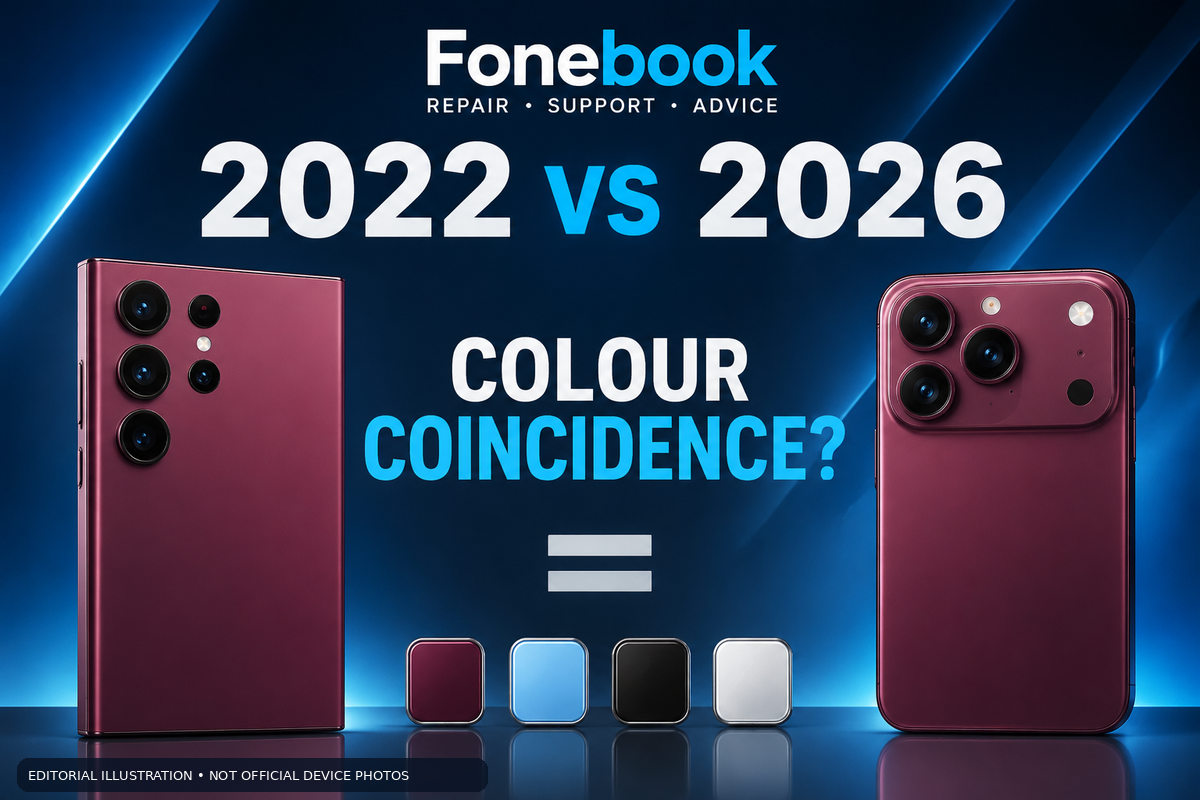
*Image note: our branded graphics are original editorial illustrations, not official Samsung or Apple photography. Consult the linked manufacturer announcements for authentic product images and finish descriptions.*
First, the confirmed launch timeline
This is not a comparison of leaks or unannounced phones. Both product announcements are documented by their manufacturers.
| Event | Confirmed date | What was announced |
|---|---|---|
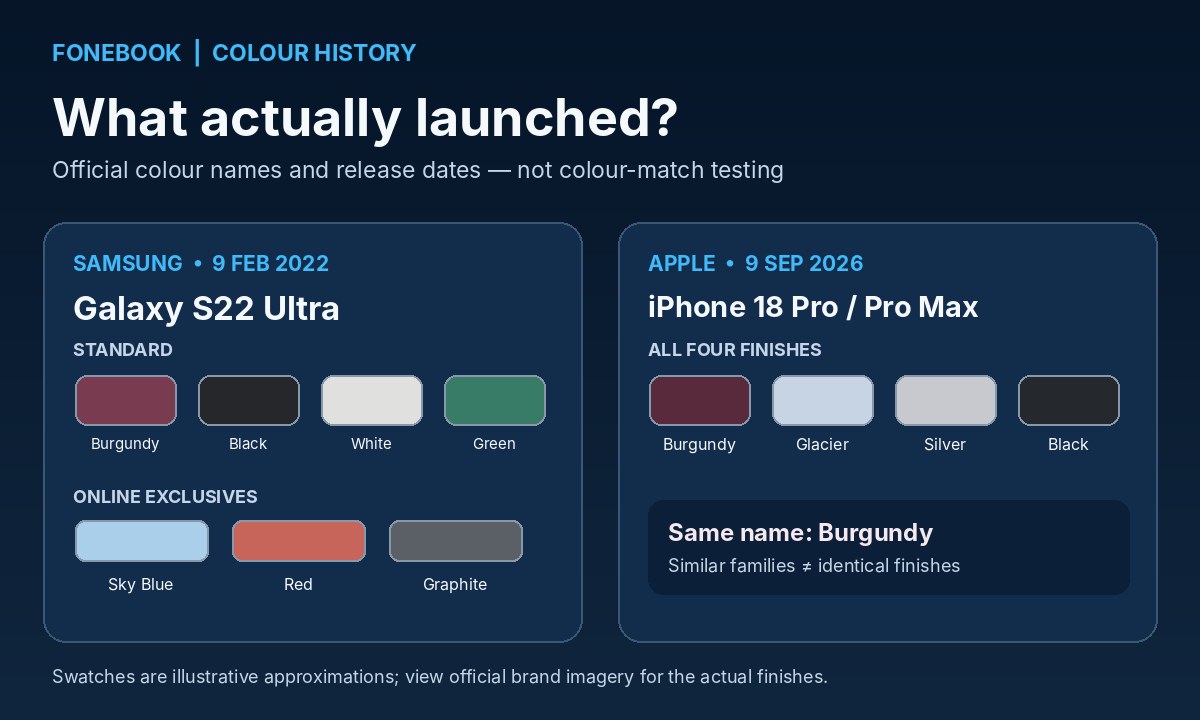
| Samsung unveils Galaxy S22 Ultra | 9 February 2022 | Phantom Black, Phantom White, Green and Burgundy as the main colours |
| Samsung details S22 Ultra web exclusives | 10 February 2022 | Graphite, Red and Sky Blue, sold through Samsung's online store in selected markets |
| Apple unveils iPhone 18 Pro / Pro Max | 9 September 2026 | Black, Silver, Glacier and Burgundy |
| iPhone 18 Pro availability begins | 18 September 2026 | The announced models became available in the UK and other launch markets |
The gap between Samsung's unveiling and Apple's unveiling is four years and seven months. The chronology isn't disputed. The question is what it means.
The original information is available in Samsung's UK Galaxy S22 Ultra announcement, Samsung's online-exclusive colours announcement and Apple's UK iPhone 18 Pro press release.
What colours did the Galaxy S22 Ultra actually have in 2022?
Samsung's standard 2022 Galaxy S22 Ultra line-up offered four finishes: Burgundy, Phantom Black, Phantom White and Green. Burgundy wasn't an obscure aftermarket shade or a fan-made render; it was one of the colours named in Samsung's own UK launch announcement.
Samsung expanded the selection with Sky Blue, Red and Graphite as online exclusives in selected regions, including the UK. It's worth getting that detail right. Sky Blue was not one of the four main high-street colours. Likewise, the online-exclusive Red should not be confused with the standard Burgundy finish: Samsung marketed them separately.
That means the S22 Ultra had seven named finish options across its main and selected online ranges. Availability could vary by region and retailer, but the official announcement documents all seven names.
Samsung's original product launch can be viewed here, and its official online-exclusive range can be viewed here.
What colours are on the iPhone 18 Pro in 2026?
Apple lists the same four options for both the iPhone 18 Pro and iPhone 18 Pro Max: Black, Silver, Glacier and Burgundy. Apple introduced them when it unveiled the phones on 9 September 2026, with UK availability beginning on 18 September.
The headline finish is Burgundy: a deep, wine-like colour rather than the bright Cosmic Orange associated with the previous iPhone 17 Pro generation. Glacier is a lighter, cooler-looking option. Black and Silver provide the more familiar neutral choices.
For the exact finish names, body materials and official photos, see Apple's UK product specification and Apple's launch announcement.
Samsung S22 Ultra vs iPhone 18 Pro: how close are the colours?
Here's the useful comparison, without pretending that two differently named finishes must be identical.
| Galaxy S22 Ultra — 2022 | iPhone 18 Pro — 2026 | Our assessment |
|---|---|---|
| Burgundy | Burgundy | Exact name match. Both are dark red/purple-family finishes, but the name does not prove an identical shade or colour formula. |
| Sky Blue (online exclusive) | Glacier | Broad visual similarity. Both are pale, cool-toned blues; the names and actual appearance are different. |
| Phantom Black | Black | Same basic colour family. Black phones are common across manufacturers and generations. |
| Phantom White | Silver | Only a loose comparison. White and metallic silver are not the same finish. |
| Green, Red and Graphite | No direct equivalent in the four-colour Pro launch | No one-for-one match. Samsung offered additional choices. |
The Burgundy-to-Burgundy comparison is the strongest because Samsung and Apple explicitly used the same colour name. The blue comparison is reasonable to discuss, but it is less exact. Black is hardly unusual, and calling Phantom White the same thing as Silver would overstate the case.
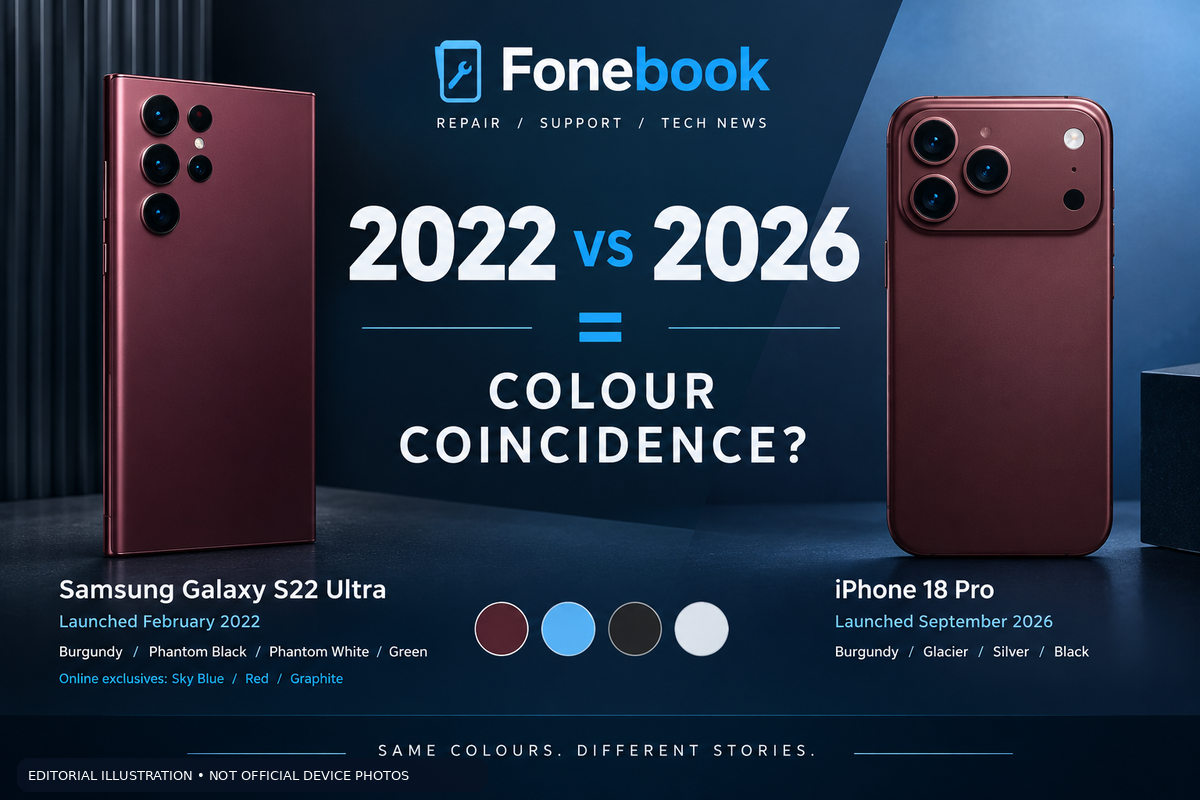
*Important: screen brightness, colour calibration, lighting, reflections and materials can change how a phone looks in photographs. We have not performed a laboratory colour-match test on physical devices.*
Why Burgundy is the real talking point
If Apple had launched a black phone after Samsung, nobody would consider that meaningful evidence of copying. Black and silver have been staple electronic-product colours for decades.
Burgundy is different because it is a more distinctive marketing choice. Customers searching for a colourful flagship may remember Samsung's 2022 Burgundy Ultra, then see the same finish name appear in Apple's 2026 premium range. That naturally invites comparison.
But being first with a colour is not the same as owning the idea. Burgundy existed long before either phone. Different manufacturers can choose similar shades independently, or respond to wider fashion and consumer trends. We do not have evidence showing how Apple's designers reached their decision, so it would be misleading to describe Samsung's earlier launch as proof of copying.
Also remember that similar colours can look notably different on separate surfaces. A name is marketing language, not a publicly certified numerical specification for the paint, anodising or glass finish.
What did Samsung actually say about Apple's 2026 launch?
This is where the advertising story needs separating from the colour debate.
On 9 September 2026, as Apple introduced its latest devices, Samsung Mobile US posted "So far, so same" with the hashtag #ItsTimeToSwitch. Other posts joked about familiar-looking updates and Apple's entry into foldable phones. Contemporary reporting from Mint and MobileSyrup describes the launch-day exchanges.
Samsung's more sustained foldable advertising is a separate matter. Reuters reported on 10 September 2026 that Samsung was advertising its foldable experience in the wake of Apple's iPhone Duo introduction. On 26 October, Android Authority reported on a Samsung-sponsored Instagram advertisement that contrasted Apple's foldable with the Galaxy Z Fold 8, making a point about years of foldable experience.
What those reports support: Samsung has been actively teasing Apple in its marketing.
What they do not establish: that Samsung published a specific official advertisement saying Apple's Burgundy, Glacier, Silver and Black iPhone 18 Pro finishes were copied from the 2022 Galaxy S22 Ultra.
The distinction matters. It would be an eye-catching headline, but attributing the colour allegation directly to Samsung without the original advertisement would not be responsible reporting.
Have Apple and Samsung borrowed ideas from one another before?
For years, the rivalry has involved features that appear on one company's phones and later become part of another's range. Large OLED displays, fast refresh rates, camera features, wireless charging and multiple-camera systems have spread across the industry over time. A feature becoming widespread does not, by itself, establish who invented it or why another company adopted it.
Marketing plays a role too. A manufacturer that reaches a category first may emphasise its head start, while another may argue that its version offers a better overall experience. Samsung's reaction to Apple's 2026 foldable launch is a clear example of that kind of competitive advertising.
Colour choices are a softer argument than an identifiable technical feature. A matching name is a fact; a claimed design origin would require evidence of design intent. We should not confuse the two.
Is the 2022 Galaxy S22 Ultra comparable to a 2026 iPhone 18 Pro beyond colour?
Not as a direct like-for-like buying comparison. They're premium phones from different generations and ecosystems, more than four years apart.
The S22 Ultra combined the Galaxy S and Note ideas, including an integrated S Pen, and was designed around Samsung's flagship Android experience in 2022. Apple's iPhone 18 Pro range uses the newer A20 Pro generation, features a variable-aperture main camera and runs Apple's iOS ecosystem. Those details belong to different eras, so we wouldn't judge the 2026 iPhone solely by a 2022 handset's colour palette.
If you're choosing a phone now, consider operating system, camera results, battery condition, software support, repair cost, warranty, storage and price. A finish might be the final deciding factor — but it shouldn't be the only one.
A repair-shop perspective: the colour has practical consequences
At Fonebook, we look at devices from the perspective of keeping them working, not just making them look good in marketing photographs.
A Burgundy finish is attractive, but if a phone later needs a housing, rear-glass or frame-related repair, matching the correct model, colour and finish matters. You cannot assume one model's Burgundy part matches another model's Burgundy — or even that a third-party replacement matches the manufacturer's original colour perfectly.
This is especially important with modern flagships, where coloured frames and rear glass can reflect light differently. Apple lists an aluminium unibody design and Ceramic Shield back for the iPhone 18 Pro. The 2022 Galaxy S22 Ultra has its own distinct construction and parts. A finish comparison does not tell you whether two phones have similar repair procedures, costs or durability.
For any model, check the actual parts offered, ask about colour matching, and confirm the warranty terms before authorising a repair. We won't invent a repair price for a new model without checking parts and availability.
If you need help with an iPhone or Samsung Galaxy, explore Fonebook's phone repair options, book a diagnosis or visit our shop at Unit 5 Cotsford Lane, Horden, SR8 4JJ, near Peterlee.
So, did Apple copy Samsung's S22 Ultra colours?
Our conclusion is deliberately narrower than the viral claim:
- Confirmed: Samsung released the Galaxy S22 Ultra in Burgundy in February 2022, and offered Sky Blue as an online exclusive.
- Confirmed: Apple released the iPhone 18 Pro range in Burgundy and Glacier, along with Silver and Black, in September 2026.
- Fair comparison: The Burgundy name matches exactly, while Sky Blue and Glacier share a broadly cool blue appearance.
- Not established: That Apple's colours were derived from Samsung's designs, or that the two companies used identical shades.
- Important context: Samsung's recent jabs at Apple are real, but the verified advertising reports discuss the wider 2026 launch and foldable rivalry, not a confirmed S22 Ultra colour-copying advertisement.
Fonebook's verdict: Samsung did get to this particular Burgundy name first — by roughly four years and seven months. That's a fun, verifiable observation. Whether Apple was inspired by Samsung is something we cannot know from the colour names alone.
What do you think?
Is the iPhone 18 Pro's Burgundy finish a coincidence, a shared trend or a nod to a colour that Galaxy fans have known for years? Tell us which finish you prefer — Samsung's 2022 Burgundy or Apple's 2026 Burgundy.
Frequently asked questions
Did Samsung use Burgundy before Apple used it on iPhone 18 Pro?
Yes. Samsung officially listed Burgundy for the Galaxy S22 Ultra on 9 February 2022. Apple announced Burgundy for the iPhone 18 Pro models on 9 September 2026.
Was Galaxy S22 Ultra Sky Blue a standard launch colour?
No. Samsung listed Sky Blue among the S22 Ultra's online-exclusive options for selected markets. The four main finishes were Burgundy, Green, Phantom Black and Phantom White.
Are Samsung's Sky Blue and Apple's Glacier exactly the same colour?
That has not been established. The finishes are in a similar pale-blue family, but their official names, materials and appearance differ. Illustrations and photographs alone are not a reliable colour-calibration test.
Did Samsung officially say Apple copied the Galaxy S22 Ultra colours?
We found verified reports of Samsung mocking Apple's September 2026 device launch and running later foldable-focused advertising. We have not verified a Samsung-issued advertisement that specifically makes that claim about the iPhone 18 Pro colours.
Is the Samsung S22 Ultra Burgundy the same as its online-exclusive Red?
No. Samsung separately named Burgundy as a standard finish and Red as an online-exclusive finish.
Does changing the rear glass or housing affect a phone's colour?
It can. Replacement parts may have different tones or textures, especially across suppliers and generations. Ask your repairer about the actual part and colour-match expectations.
Sources and fact-checking
The dates, official colour names and advertising context in this article were checked against these sources:
1. Samsung UK — Galaxy S22 Ultra announcement, 9 February 2022
2. Samsung Global Newsroom — S22 online-exclusive colours, 10 February 2022
3. Apple UK — iPhone 18 Pro launch, 9 September 2026
4. Apple UK — iPhone 18 Pro technical specifications
5. Mint — Samsung's September 2026 launch-day posts
6. Reuters — Samsung foldable campaign, 10 September 2026
7. Android Authority — Samsung-sponsored foldable ad report, 26 October 2026
*Editorial note: Updated 29 October 2026. This is independent Fonebook commentary, not sponsored by or affiliated with Apple or Samsung. All product names are trademarks of their respective owners; illustrations are conceptual and not official product photography.*